I. General finite geometry (without coordinates):
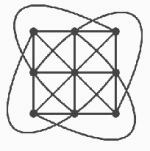
A finite affine plane of order n has n^2 points.
A finite projective plane of order n has n^2 + n + 1
points because it is formed from an order-n finite affine
plane by adding a line at infinity that contains n + 1 points.
Examples—
|
|
|

II. Galois finite geometry (with coordinates over a Galois field):
A finite projective Galois plane of order n has n^2 + n + 1
points because it is formed from a finite affine Galois 3-space
of order n with n^3 points by discarding the point (0,0,0) and
identifying the points whose coordinates are multiples of the
(n-1) nonzero scalars.
Note: The resulting Galois plane of order n has
(n^3-1)/(n-1)= (n^2 + n + 1) points because
(n^2 + n + 1)(n – 1) =
(n^3 + n^2 + n – n^2 – n – 1) = (n^3 – 1) .
III. Related art:
Another version of a 1994 picture that accompanied a New Yorker
article, "Atheists with Attitude," in the issue dated May 21, 2007:
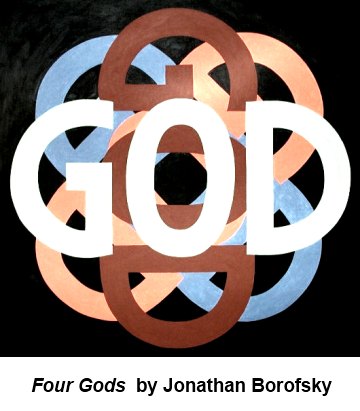
The Four Gods of Borofsky correspond to the four axes of
symmetry of a square and to the four points on a line at infinity
in an order-3 projective plane as described in Part I above.
Those who prefer literature to mathematics may, if they like,
view the Borofsky work as depicting
"Blake's Four Zoas, which represent four aspects
of the Almighty God" —Wikipedia
Leave a Reply